Some of the locals in Athens thought that the advertisement for the documenta 14 was for new sneakers. What do you think? Why documenta 14 uses at least two different kind of graphic styles in their marketing strategy? Why there are no intentions to define, what documenta is? A film festival? A fashion week? A concert? Based on this would you know what is happening in town?
Thursday, 15 June 2017
Observations on documenta 14 II
We booked a walk /
guided tour to EMST which was a tremendous help for understanding the works
displayed at the museum but also for the whole concept of documenta 14. In the
exhibition spaces there are no additional information given about the concept,
display, context or theoretical narratives. We gained this extra information
through bought service that is not accessible to everybody. This raises an
interesting question on to whom the exhibition is made for?
Observations on documenta 14 I
During our first trip to
Athens we heard so much about the up and coming documenta* 14 that it
raised our interest. Local artists and other cultural professionals were often highly critical towards the
exhibition and as a result we Ingrid and Eeva wanted to learn more about it on
our second trip to Athens.
![]() |
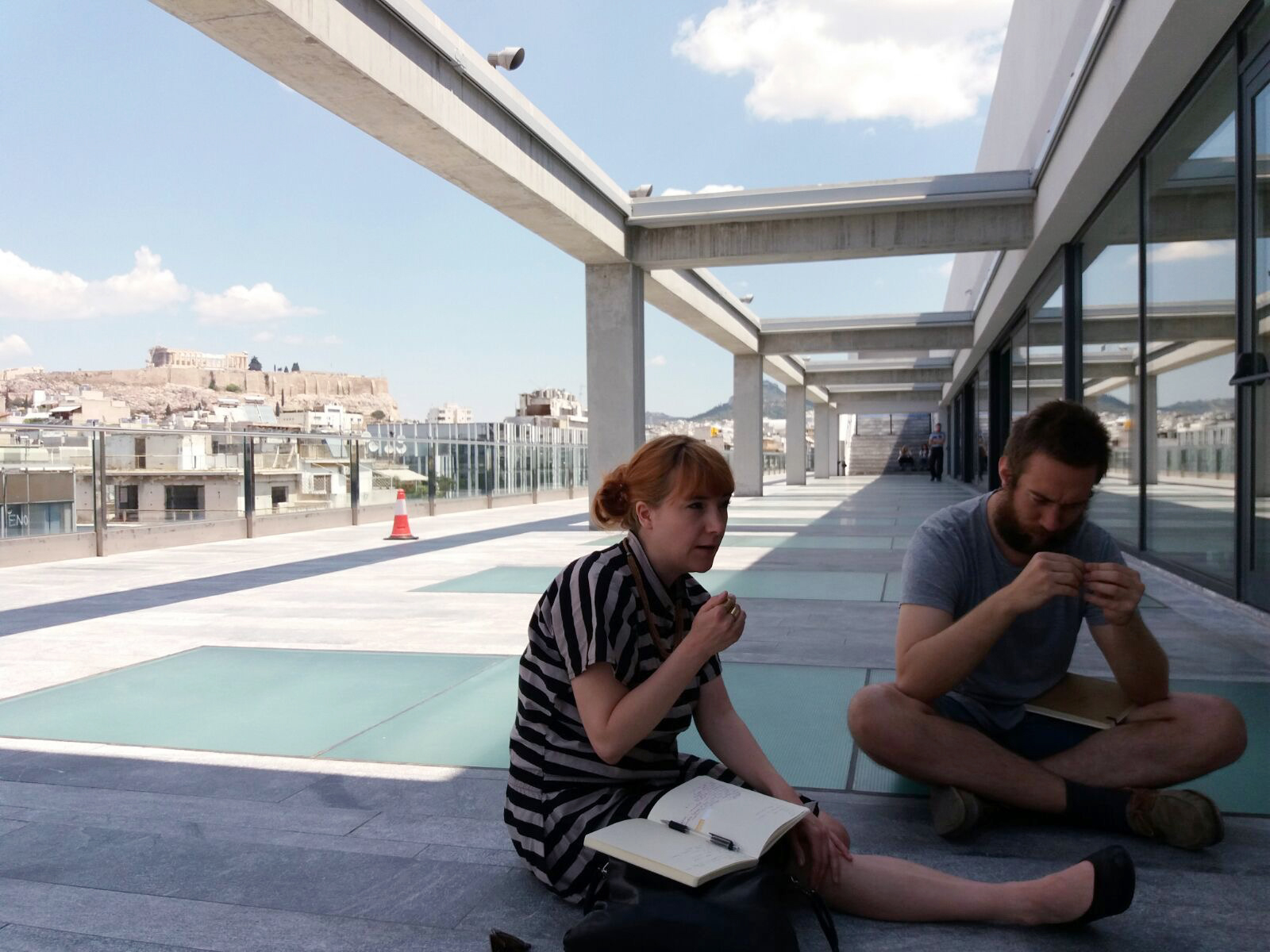
| Eeva and Ruben on the balcony of EMST |
Until today
the whole documenta 14 raises more questions than it gives answers to: Why to
bring documenta 14 to Athens? Why this edition is called Learning from
Athens? What kind of narratives documenta 14 wants to tell? What impacts it
has on Athens (in Europe) and/or in the cultural field, everyday life?
One explanation for the question “why Athens?” is given in the article by iLiana Fokianaki: The director of dokumenta 14, curator Adam Szymczyk, explained to have taken the inspiration for an ‘Athenian learning experience’ from the fourth Athens Biennial of 2013, entitled Agora. But in Szymczyk’s public lectures throughout his two-year presence in Athens, it remained vague what exactly had inspired him. The only thing he declared was that documenta would be ‘guest’ rather than host in Athens. Athens: a city with the symbolic value of being a place and space where European ideals emerge, whilst simultaneously a paradigm of any city operating in crisis.
![]() |
| The entrance to EMST |
We searched thought the catalogues, press releases and webpages for answers without any real answers.There is a lot of information about the venue places (for example discription about the EMST, an old brewery building or the Athens Conservatoire, an unfinished cultural center from the 1960's), about the curators and some light details about the artists. We are certain that Adam Szymczyk, the Artistic Director of documenta 14 and the team of documenta had reasons for all of this but it is definitely not easily found in any of the material given to the audience or the press for that matter. Even if this is deliberate we are left guessing. This guessing game results in different interpretations that might not be so useful for the exhibition.
[* Documenta – first time organised in 1955 – is a contemporary art exhibition organised in every five years in Kassel, Germany. The documenta 14 and the National Museum of Contemporary Art (EMST) in Athens started conversations in early 2014 that the exhibition would be realised in both cities. The idea for this came initially for Adam Szymczyk, who also came up with the official title Learning from Athens for both exhibitions.]
Friday, 26 May 2017
Wednesday, 24 May 2017
Some thoughts on institutional critique.
![]() |
| *This image is only related to the text in that it was created at the same time. |
Institutions inherently need consumers/participants but they also seek to use or exploit them as fuel for their machine. Skepticism of institutions therefor attempts to balance this relationship. Finding, highlighting, and exploiting flaws between what the institution says and its actions as well as their reasons for doing so is a responsibility of the participant/consumer in order to keep that institution working FOR its audience rather than for the forces which press upon the institution from the opposite direction.
Tuesday, 23 May 2017
Learning by Walking
After a long day of walking, Dr. Martins feel heavy on your feet. The sun has sinked from the highest point of the sky. As you walk a narrow street bright daylight and dark shadows alter between one another creating heavy contrasts that your eyes have trouble adjusting to. You pass several businesses, that have closed their doors. With your hands around the face, you peak in from the windows. Coffee beans, cezve, sugar dispensers and cutlery on a countertop of a restaurant that is filled with empty tables. Next door you see a hairdresser's chair that is designed for washing hair. Windows covered with graffiti and interior deteriorating, these spaces have been out of business for years now. It looks as if an emergency has swept over the city, leaving only a ghost down behind.
The impressions quickly change as you continue the journey. You take a path that follows the edge of a park with branches of blossoming trees bending to the sidewalk. Your gaze wanders in from the window of a basement apartment. A lazy cat is liking themselves on the windowsill, while a young woman is slouching on a bed and smoking a cigarette.
Among buildings that are mostly from 1980’s /1990's, there are some that based on the influenced of Bauhaus appear to be from the 1930’s. Their marble entrances and New York style front desks, give away that these used to be for the rich. Once an area for the high society, these buildings are now habited by families mostly with immigrant backgrounds. Because their apartments are small and crowded the outdoor air has its appeal. The streets are filled with playing children, while men sit in cafes and sip their expressos. A maple tree gives a pleasant shadow. Even though it looks out of place here because of the dry climate, it is able to grow thanks to the river that used to be here before it was filled on the requests of the citizens.
While relying on intuition as your guide, and not using a map, the overall picture of the city is fragmental. While there lacks a feeling that I know where each part of its body lies, these walks have produced knowledge of the city on a horizontal level. As I recognising bits and pieces, I am able to find threads that finally lead me back to the hotel.
Subscribe to:
Posts (Atom)